AI-native Audit Platform
Skepta moves your internal audit out of scattered emails and spreadsheets into one system of record - every information request, response, observation and action plan, recorded, time-stamped, traceable and ready to query in plain English.
Unlimited users in every role · AI assistant included
For in-house internal audit teams.
Internal audits, stock audits, IT and systems, health & safety, forensic reviews - any audit that runs inside the organisation to improve how the business runs.
Many units. Many cycles. One record.
For enterprises that audit several business units, several times a year and need every cycle to build on the last instead of starting over.
No training. No new habits.
Auditees respond from the portal or by simply replying to the email, as usual. Either way, their response is logged automatically, against the right information request or observation.
The problem
Audits rarely fail in the field. They fail in the follow-up.
Documents, responses and action plans - all run on email, spreadsheets and memory. Nobody holds the whole record, and management sees none of it until the draft report lands.
- 01
Requests nobody chased on time
The document list goes out on day one. Follow-ups happen only when someone stops to take stock. Files arrive weeks later.
- 02
Responses nobody can find
Observations go out. Auditee replies trickle back across a dozen email threads or different file versions.
- 03
Fixes nobody checked
An owner and a date get agreed, then parked in an audit report. Whether the fix happened depends on someone remembering to look in the right file.
- 04
Blame nobody can settle
“I sent it.” “You never replied.” With the record scattered across inboxes and spreadsheets, nobody can prove who dropped what.
So the audit outcome becomes a pending-points tracker, instead of a list of gaps identified.
The Skepta loop
One loop, every cycle. Nothing falls out.
Skepta puts the whole audit on one record, so management can see where it stands on any day, not just when the report lands. Every request and reply is timestamped, escalation runs itself, and every gap fixed is verified by the auditor in the next cycle.
- 01Plan
Set up the audit plan with owners and milestones.
Focus areas become procedures in the audit plan, each with an owner and a due date. Hand any procedure to Skepta AI Analyst and it lands in the Analyst’s queue, ready for auto-processing (with auditor-in-the-loop).
Who acts → Auditors
Audit plan · A-27-001Chakan Plant · H1 FY2714 procedures- AP-025Duplicate invoice analytics on Q1 paymentsIn progressSkepta AI AnalystDue 20 Jul
- AP-026Three-way match exceptionsNot startedSneha IyerDue 22 Jul
- AP-031Physical verification of storesIn progressKaran ShahDue 24 Jul
- 02Fieldwork AI
Raise information requests and post observations.
Each request and observation is assigned to one or more auditees along with a due date. Auto reminders and escalations roll out when things are due soon or overdue. Skepta AI Analyst runs audit analytics and documents the process, with the auditor approving every step.
Who acts → Auditors · Skepta AI Analyst
A-27-001/IR-003ReceivedVendor payment register, Apr–JunMeera Joshi · reminder sent Tue · uploaded WedSkepta AI Analyst · AP-025Run 1- 48,212 payments reconciled to the trial balance
- Exact and fuzzy duplicate matching
11 duplicate pairs · ₹14.6 L3 vendors - 03Review & release
Observations go through review and approval.
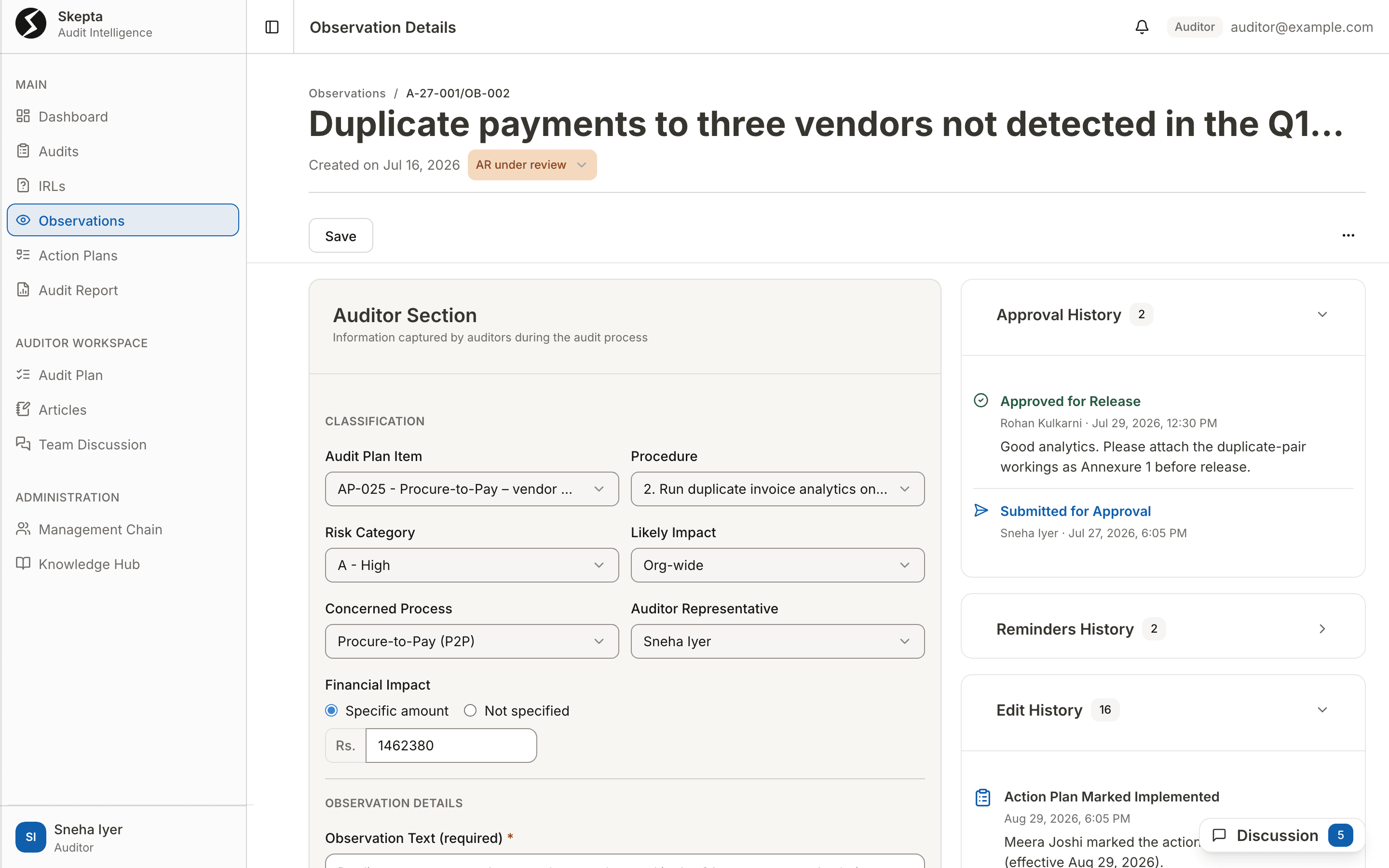
The audit team drafts observations; the audit head approves and releases them to auditees. Until then a finding is invisible outside the audit team.
Who acts → Audit team drafts · audit head releases
A-27-001/OB-002Duplicate payments to three vendors not detected in Q1Pending AR- DraftedSneha Iyer16 Jul
- Submitted for approvalSneha Iyer27 Jul
- Approved for releaseRohan Kulkarni29 Jul
- Released to managementRohan Kulkarni29 Jul
“Good analytics. Attach the duplicate-pair workings as Annexure 1 before release.” - Rohan Kulkarni - 04Respond
Auditees reply from their inbox.
Auditees respond in Skepta, or simply reply to the email. Either way, their response is logged against the right request or observation in Skepta automatically, along with their attachments, if any. All responses are timestamped.
Who acts → Auditees
Meera JoshiTue 18 AugRe: [A-27-001/OB-002] Duplicate payments to three vendors not detected in Q1₹9.10 lakh is already recovered. The balance of ₹5.52 lakh from V-11307 will be recovered by 15 Sep, and IT has raised CR-2026-114 to switch on SAP’s duplicate check.
Recovery_ledger_V-10482.pdfManagement response · received by emailFiled on A-27-001/OB-002 with 1 attachmentAR under review - 05Remediate
Management action plans are recorded against finalised observations.
Action plans carry named owners and target dates. Reminders arrive before the date, and overdue plans are escalated automatically.
Who acts → Management
A-27-001/OB-002/AP-001Recover the balance of ₹5.52 lakh from vendor V-11307OverdueOwner Meera JoshiTarget date15 Sep 2026- Reminder on due date
- Overdue notice, day +1
- Escalated to Neha Kapoor
- 06Validate
Auditors validate action plans in the next audit cycle.
When a plan is marked implemented, the next cycle’s auditors test it and rule: implemented as planned, implemented but ineffective, or not implemented.
Who acts → Next cycle’s auditors
Audit validation · H1 FY28Switch on SAP’s duplicate-invoice check (company code 1100)From FY27Implemented as plannedImplemented but ineffectiveNot implementedDuplicate test re-run on Q1 FY28 · no new pairs · validated by Farah Qureshi …and the next audit cycle starts with everything this one recorded.
Skepta AI Analyst · audit analytics co-pilot
Analytics your team can sign - and anyone can re-perform.
Assign the Analyst to any procedure in the audit plan. It plans the tests, proves the data is complete, runs them across the full population on a deterministic engine and assembles the workpaper - stopping wherever judgment belongs to an auditor.
- 1Test planThree tests - duplicate invoices (exact and fuzzy), vendor–employee matches, weekend postings. The payment register already arrived via IR-003; the vendor master is requested.
- 2Data Quality CertificateVendor payments, Apr–Jun: 48,212 rows · ₹212.4 Cr · reconciled to the trial balance. No test runs on a population nobody accepted.
- 3Thresholds & parametersFuzzy match ≥ 92% · amount tolerance ₹10 · 30-day window - each with a default and a reason, then frozen into the run record.
- 4Run0 duplicate pairsscanning…
- 5Workpaper, ready to review
- DA-AP-025 v1 · Internal documentation.pdf
- DA-AP-025 v1 · Results workbook.xlsx
- DA-AP-025 v1 · Draft observation.xlsx
A governed, versioned test library
- Exception tests
- Duplicate payments, vendor–employee matches, weekend postings, three-way-match breaks, ghost-employee indicators, negative inventory.
- Statistical
- Stratification, monetary-unit and random sampling, Benford analysis, trend and ratio analytics - expectation first.
- Advanced
- Vendor clustering and process mining - reported as risk indicators with plain-language reasons, never as findings.
Data arrives however it can. Upload ERP extracts or ask the Analyst to pull them from an information request.
What the AI never does
- Rate severity or form a conclusion
- Write to the audit record without a named person
The entire flow is as per the ICAI Standards on Internal Audit - steps that can be reviewed, documentation that allows an experienced auditor to independently re-perform the test, with dataset fingerprints and test versions in the annexure.
Ask Skepta
An assistant that has read every audit you’ve done.
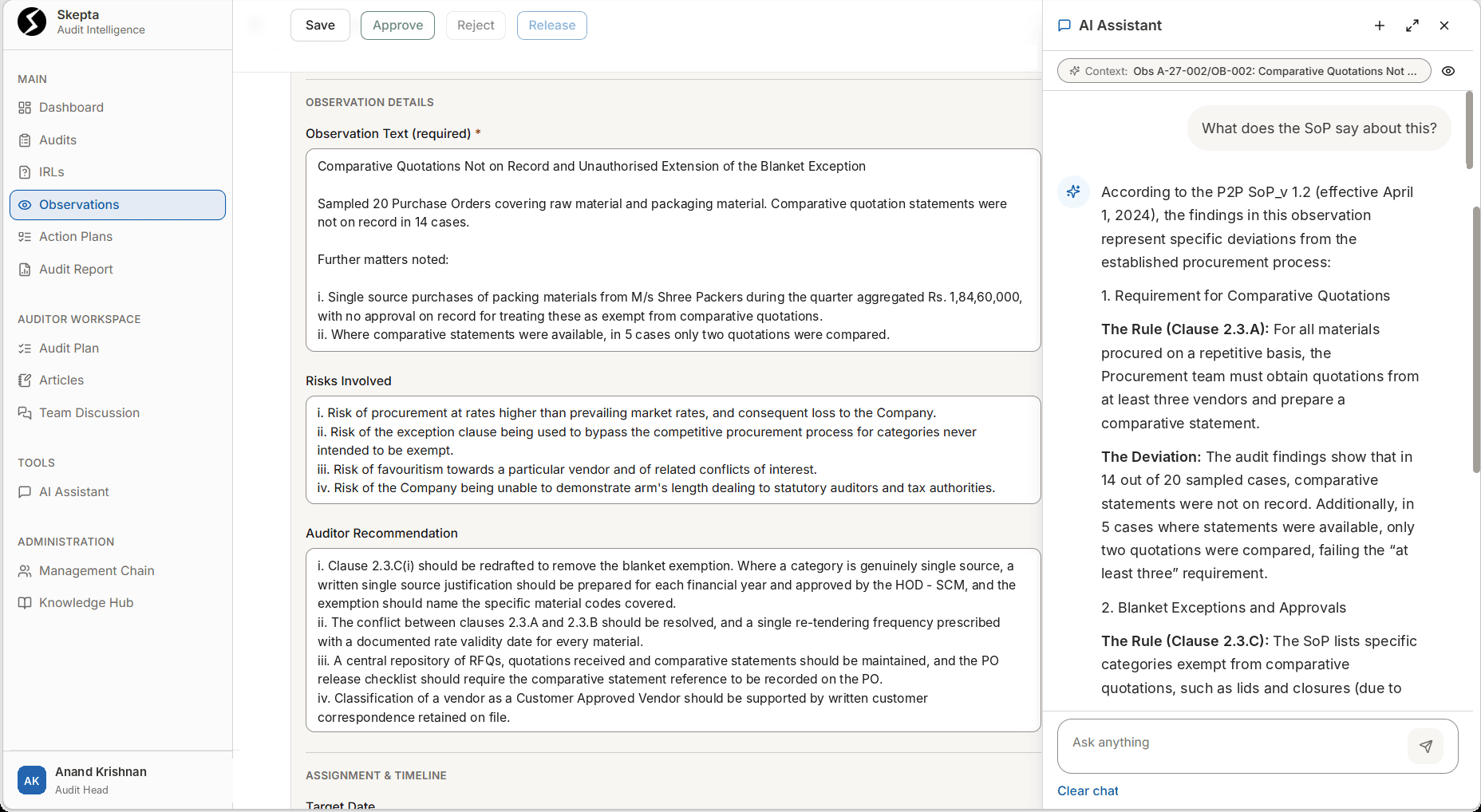
Ask in plain English across plants, cycles, policies, SOPs, RCM and audit walkthrough notes - get an answer grounded in your own records that aids your decision making.
Checked twice
A second, independent model reviews every answer before you see it.
No figure without a record
A non-AI gate blocks any number that can’t be traced to the data.
Sees what you see
Permissions are enforced in the database, not in the prompt.
On every page
Opens anywhere and knows which audit, observation or filter you’re on.
- Searched FY26 observations rated high
- Joined 31 action plans
- Read FY27 validation outcomes
Pilot studies
Observed during pilot deployments.
- About 90%
- fewer audit-related emails, as the communication exchange moved to the portal.
- About 80%
- less time compiling pending lists and status updates for management.
- About 50%
- faster draft report generation, with AI-drafted summaries and process-wise segregation.
Auditees responded sooner
Each person could see exactly what was waiting on their desk.
Management saw the audit as it ran
With their own login, plus escalation emails when items went overdue.
Observations got sharper
Root causes correlated against SOPs, past findings and past management responses before the auditor wrote a word.
Figures observed in pilot deployments and reported by participating teams; not independently verified. Results depend on team size, audit scope and prior process.
Follow-through, automated
The system chases. Your team audits.
Chasing people eats more of an auditor’s time than auditing does. Skepta takes it over and keeps a timestamped record of who was asked, when, and what they said.
Reply by email. No login needed.
Auditees answer straight from their inbox. Their reply becomes the official auditee response and attachments are screened and filed against the finding.
Awaiting management response…
Escalation that climbs the org chart.
A heads-up before the date, a reminder on it, an overdue notice the day after, then the owner’s manager and plant leadership. The system chases, so your auditors can focus on the work.
- Heads-upBefore the dateMeera Joshi, ownerBefore the date
- ReminderDue dateMeera Joshi, ownerDue date
- Overdue noticeDay +1Owner, audit team copiedDay +1
- EscalatedDay +2Neha Kapoor, manager · plant leadershipDay +2
- Tue 08 Sep 08:00 · heads-up to Meera Joshi
- Tue 15 Sep 08:00 · due today - reminder sent
- Wed 16 Sep 08:00 · overdue notice · audit team copied
- Thu 17 Sep 08:00 · escalated to Neha Kapoor
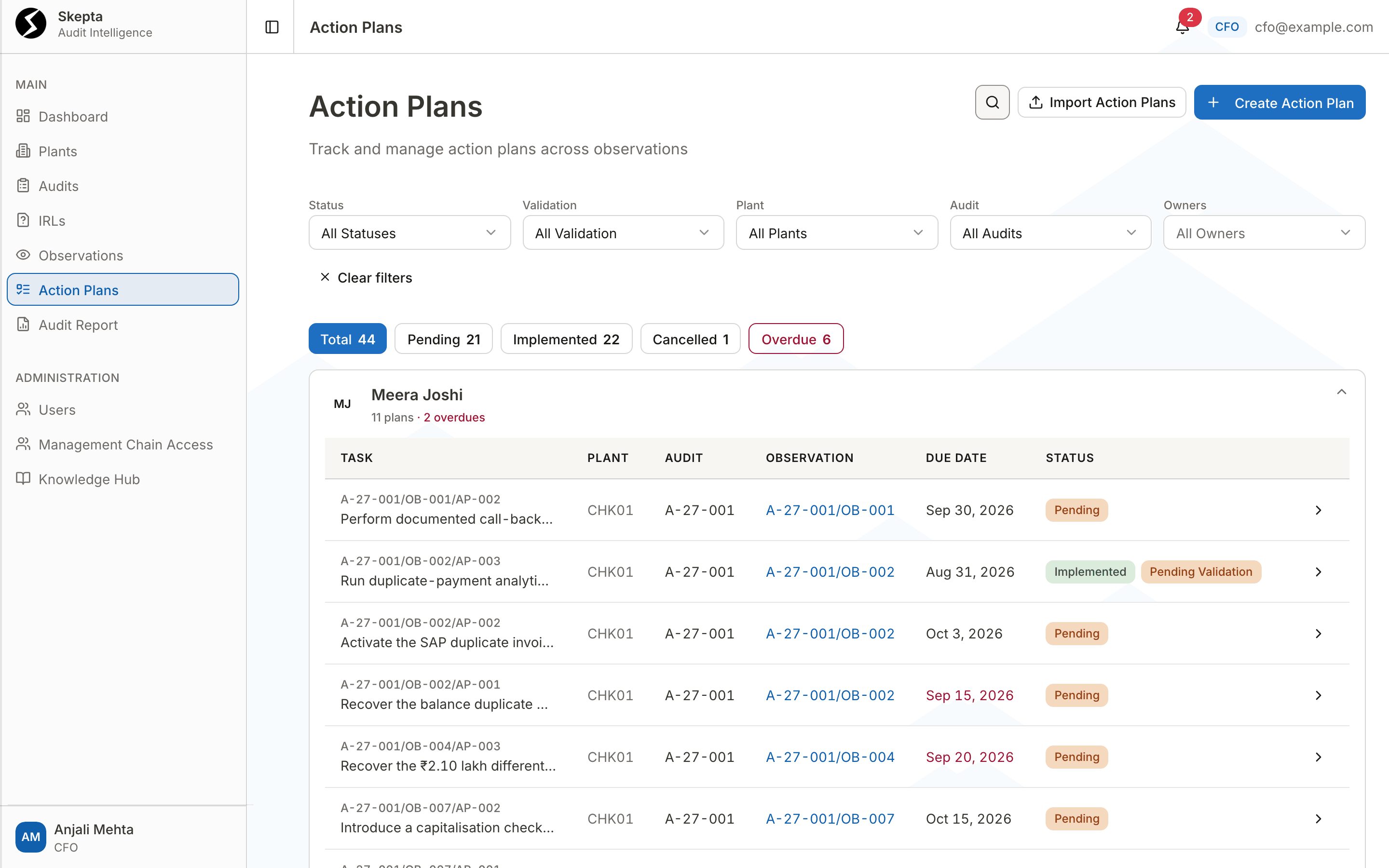
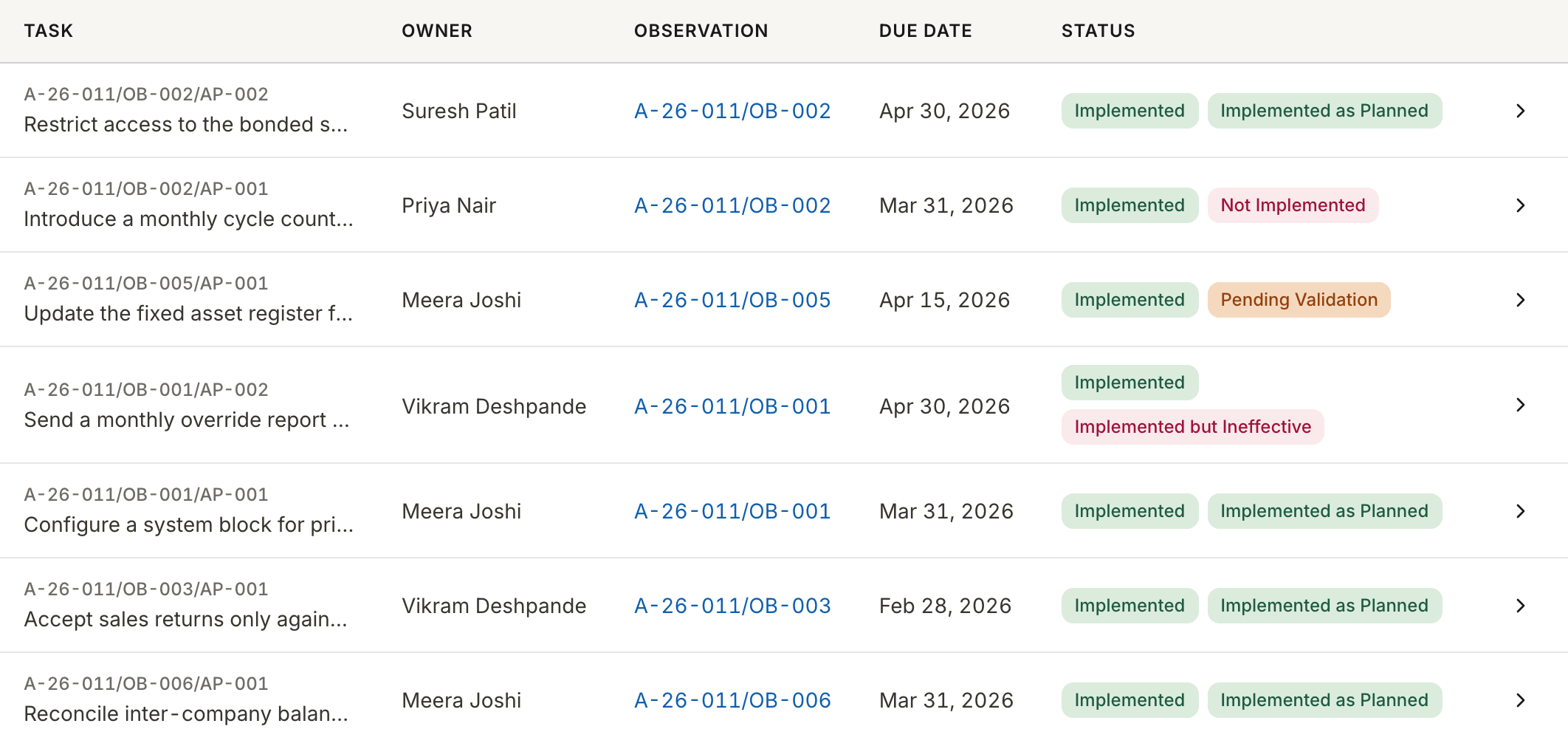
The action-plan register comprising owners, target dates, overdue flags and next-cycle validation, across every plant.
Information request lists
Every document asked for, with an owner, a due date and urgency. An upload moves it to review; closing it is the acceptance.
Maker-checker release
Drafts stay invisible to management until the audit head approves and releases them. Independence, enforced by design.
Fixes verified by the next cycle
When management marks a plan done, the next audit team rules on it. “Done” is never self-certified.
A complete audit trail
Every edit, approval, reminder and reply - accepted or rejected - with who, when and what changed.
Reporting
The report drafts itself. The committee sees the record.
Skepta drafts the audit report from finalised observations: the top and recurring issues, response times by auditee, how the unit ranks against its peers (based on a ranking rule set by the management), and what improved since the last audit. Each process gets a written opinion, with the observation tables underneath exactly as recorded. The auditor can edit any section, regenerate one without touching the rest, and submit read-only versions to management.
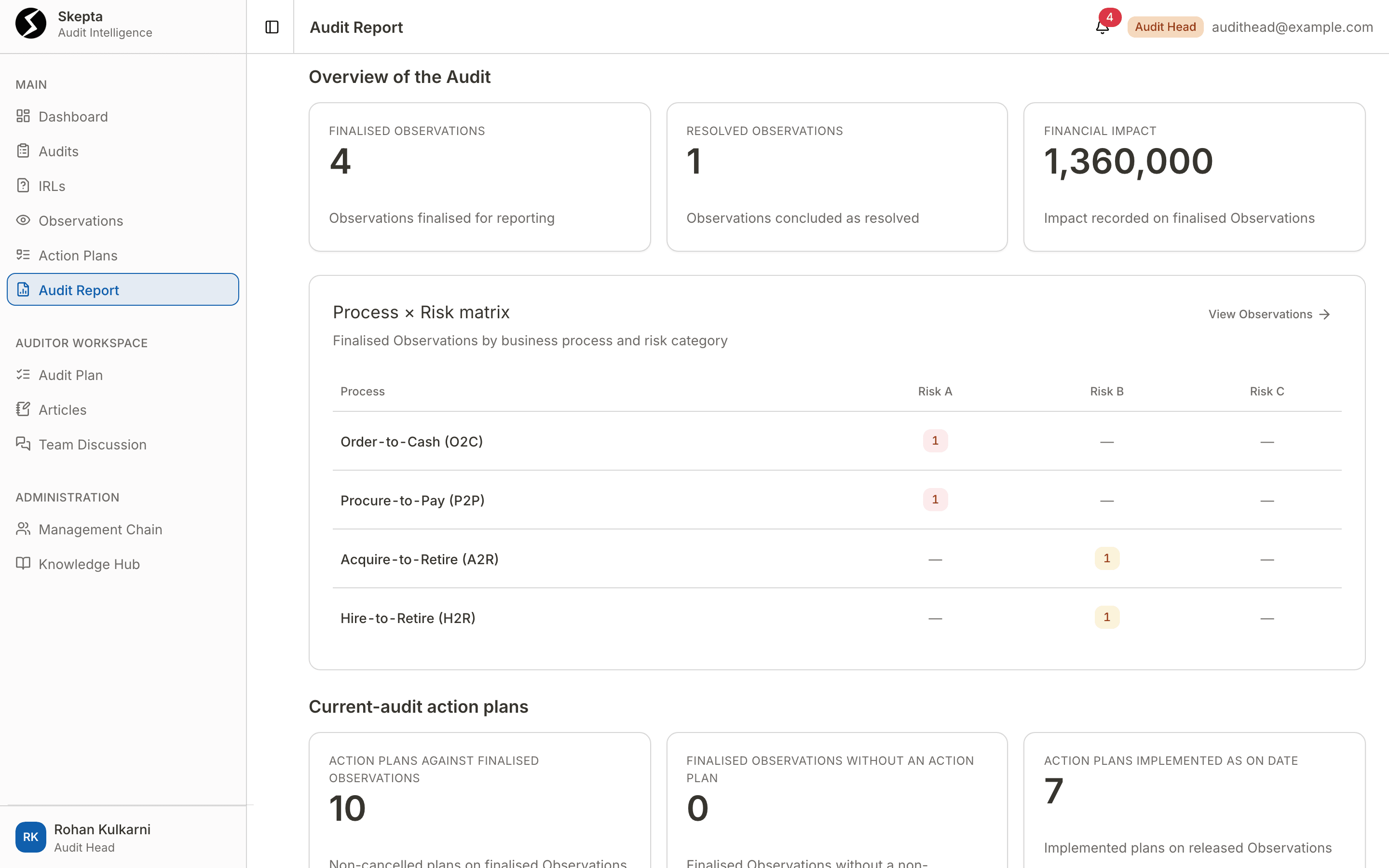
Executive summary
- 1. Payment controls are the plant’s main exposure: duplicate invoices worth ₹14.6 lakh went undetected in Q1 (OB-002).
- 2. Revenue leakage: a steel price increase was not billed to two OEM customers (OB-008).
- 3. Improved since FY26: bonded-store access is now restricted, validated as implemented as planned.
Finalised observations
- AI-drafted, auditor-edited
- Versioned submissions - V1, V2, V3
- Every metric drills down to records
- Read-only PDF for the management
Everyone in the loop
One record. Every seat at the table.
Run a four-person team with the reach of ten.
- Raise information requests or observations by tagging anyone in the organisation.
- Chasing, reminders and escalation run themselves.
- Independence protected by the release gate.
Security & AI governance
Built for sensitive audit data. Named for skeptics.
Professional skepticism is an auditor’s first discipline. Skepta is built to survive yours - the security whitepaper, AI data-usage policy, DPA and sub-processor list are ready before you ask.
Your own instance
A dedicated application, database and file store for every client. Nothing is shared.
AI sees what you see
Permissions are enforced in the database, not the prompt - and tested continuously.
People decide
The AI is read-only against the audit record. Nothing is approved, rated or concluded without a named person.
Numbers you can trace
Figures come from records and a deterministic engine - never from the language model.
Never trained on your data
No model is trained or fine-tuned on client data, and AI providers are held to no-training terms.
Your switch
Turn AI off for your instance, or choose which AI provider it uses.
Access by role and plant
Six roles, plant-level scoping for leadership, and fenced read-only access for the committee.
DPDPA-ready
No data selling, no ad tracking, a disclosed sub-processor list and deletion at contract end.
Questions
Asked by every skeptical buyer.
Do auditees and managers need licences?
No. Every role is unlimited - auditors, auditees, their managers, plant leadership, the CFO and the audit committee. Follow-through only works if everyone in the loop is in the system.
Is the AI an add-on?
No. AI is included in every plan and never metered, so nobody has to ration questions to Ask Skepta or runs of the Analyst.
Where does our data live?
In your own dedicated Skepta instance - its own application, database and file store, not shared with any other client.
Is our data used to train AI models?
No. No model is trained or fine-tuned on client data, AI providers are held to no-training terms, and you can switch AI off for your instance entirely.
Will the AI make audit judgments?
No. It proposes tests and drafts; a named person accepts every dataset, confirms every threshold and signs every workpaper. The AI never rates severity or concludes.
What happens to action plans after the audit closes?
They stay live: owners, target dates, reminders and escalation carry on until the next audit cycle tests each one and records whether it was implemented as planned.
Ask it anything about your last two years of audits.
The fastest way to judge Skepta is to see it on your own data. Here’s how a trial works.
- 1Share two past audit reportsUnder NDA. We load them into a private sandbox - nothing leaves it.
- 2Watch Skepta work on your own findingsAsk it about your plants, your repeat issues, your open action plans.
- 3Run a full cycleIf your team votes to go back to spreadsheets, you get a full refund.